Posts

Yeast-Produced Vaccines Delivered via Functional Foods: A New Era in Immunization

 Introduction Vaccination has historically relied on injectable routes, cold-chain storage, and trained personnel, posing challenges in global immunization coverage. Recent biotechnological innovations are shifting the paradigm toward edible vaccines and functional foods. One promising avenue involves using genetically engineered yeast, specifically Saccharomyces cerevisiae, as a vaccine production platform, and delivering these antigens via fermented or processed foods. This convergence of synthetic biology, industrial fermentation, and nutraceuticals offers a potent, scalable, and needle-free alternative to traditional vaccines. Why Saccharomyces cerevisiae? Yeast has long been a workhorse in biotechnology due to: GRAS (Generally Recognized as Safe) status by FDA Extensive history in bread, beer, and wine production Established genetic manipulation tools Ability to post-translationally modify proteins, unlike bacteria Saccharomyces cerevisiae has been successfully used to express...

Bioluminescent Trees: Lighting Up the Future with Biotechnology

Introduction Imagine a city where streetlights are replaced with glowing trees. This isn’t science fiction anymore—it's real science. Synthetic biology has enabled researchers to genetically engineer plants that emit light using genes borrowed from bioluminescent organisms like fireflies and certain fungi. While this technology is still in early development, it holds tremendous promise for sustainable urban lighting. The Science Behind the Glow The principle is simple: take the genes responsible for bioluminescence (like luciferase and luciferin production) and insert them into plants using recombinant DNA technology. These genes catalyze chemical reactions that emit visible light. Notable Techniques: Gene Transfer: Bioluminescent genes are inserted into Arabidopsis, Nicotiana (tobacco), or other host plants. Promoter Engineering: Modified promoters enhance expression and brightness. Fungal and Bacterial Pathways: Some studies incorporate fungal enzymes to allow continuous light em...

Resurrecting the Past: How De-Extinct Proteins Are Shaping the Future of Medicine

Image
 In the fight against drug-resistant pathogens, science is reaching into the distant past. A fascinating and rare frontier in medicinal biotechnology is the concept of molecular de-extinction—the process of retrieving and synthesizing ancient proteins from extinct species to discover new therapeutic molecules. Unearthing Ancient Antimicrobial Peptides (AMPs) A research group from the University of Pennsylvania’s Machine Biology Lab recently employed deep learning algorithms to search for antimicrobial peptides (AMPs) in the proteomes of extinct species like Neanderthals, woolly mammoths, and Denisovans. Using a custom AI model called panCleave, they simulated proteolytic cleavage and identified short peptides with potential antibacterial activity. Among their top discoveries: Mammuthusin-2 (from woolly mammoth): Active against multidrug-resistant Acinetobacter baumannii Elephasin-2 (from extinct straight-tusked elephant): Effective in preclinical models These AMPs were chemically s...

Can Mosquitoes Be Used for Drug Delivery? A Future Innovation in Medicine

Introduction Mosquitoes are infamous for their role in spreading deadly diseases such as malaria, dengue, and Zika. But what if these tiny insects could be repurposed to deliver life-saving medicines instead? Scientists are exploring the potential of using mosquitoes as biological drug delivery systems, turning nature’s most notorious vector into a tool for good. How Could Mosquitoes Be Used for Drug Delivery? Genetically Engineered Mosquitoes for Vaccination Instead of carrying pathogens, genetically modified mosquitoes could be designed to produce and inject therapeutic molecules, such as vaccines or antibodies, when they bite a human. Research has shown that mosquito salivary glands can be engineered to secrete bioactive proteins. 📌 Potential Application: Scientists are investigating whether mosquito saliva can be modified to carry vaccines for diseases like malaria and dengue, essentially transforming each bite into a mini-injection. Mosquito-Associated Microbes as Drug Carriers M...

Advancing Cancer Research with Tumoroid Technologies: A Convergence of Microfluidics, Organoids, and Immuno-Oncology

Image
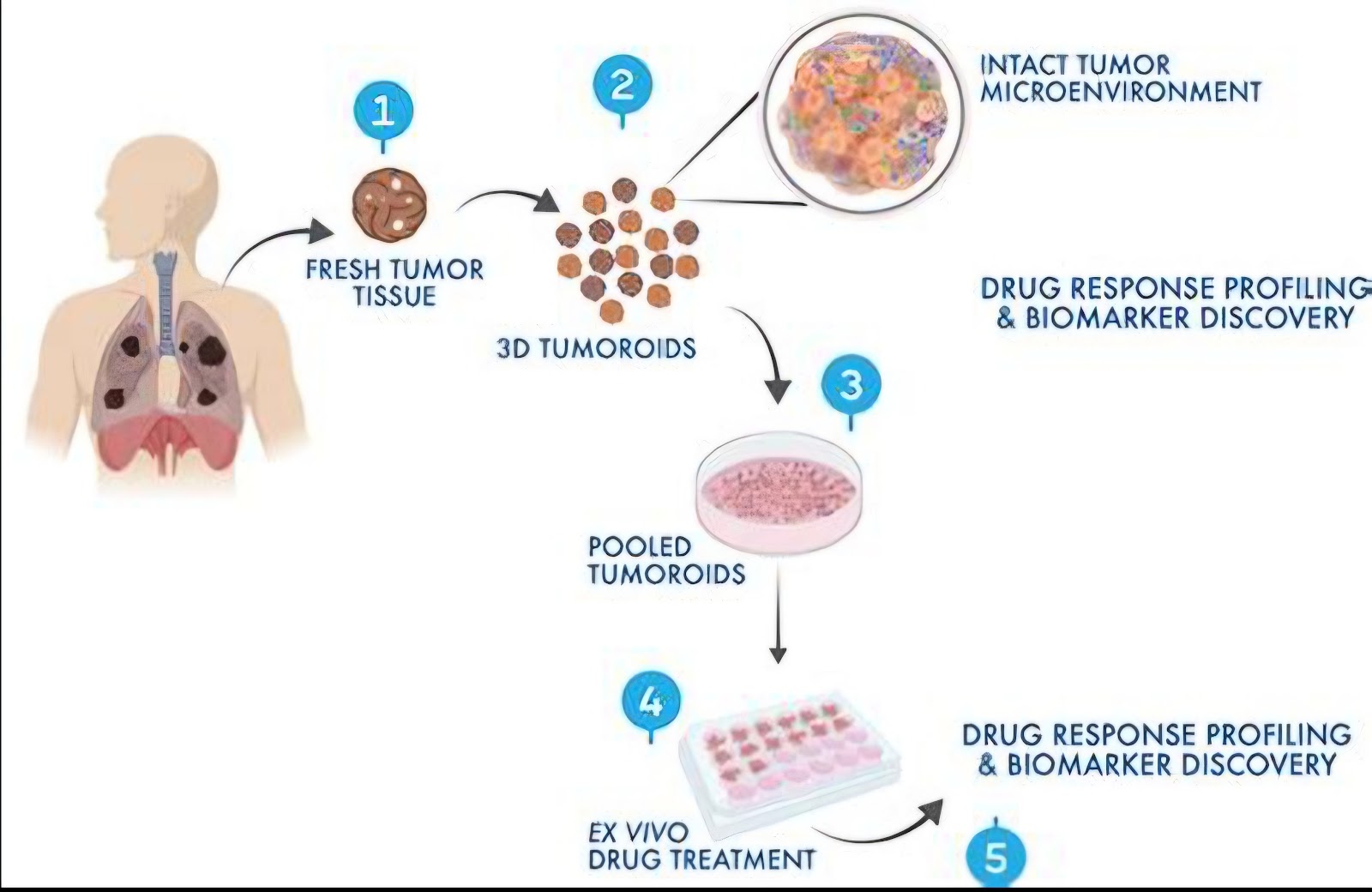
Introduction Cancer research has undergone a paradigm shift with the emergence of in vitro tumor models that closely mimic in vivo conditions. Among these, Tumoroid-on-a-Chip technology, Organoid-Tumoroid Hybrid Models, Tumoroid-Derived Extracellular Vesicles (EVs), and Integration with Immuno-Oncology Models are revolutionizing cancer biology, drug development, and personalized medicine. This blog explores these cutting-edge technologies, their applications, and their potential to transform cancer therapy. 1. Tumoroid-on-a-Chip Technology: Mimicking the Tumor Microenvironment (TME) 1.1 What is Tumoroid-on-a-Chip? Tumoroid-on-a-Chip technology integrates microfluidics with 3D tumor cultures, allowing precise control over biochemical and biomechanical signals within the tumor microenvironment (TME). These devices simulate the dynamic interactions between cancer cells, stromal cells, and blood vessels, overcoming limitations of traditional 2D cultures and animal models. 1.2 Fabrication a...

Cryo-Electron Microscopy: A Revolution in Molecular Science

Image
  Cryo-electron microscopy (Cryo-EM) has emerged as one of the most groundbreaking techniques in structural biology, enabling scientists to peer into the molecular world with astonishing clarity. Over the years, this technology has evolved from a niche experimental tool into a central method for understanding biological structures at atomic resolution . But what exactly makes Cryo-EM so transformative, and how has it reached the forefront of modern science? At its core, Cryo-EM works on a deceptively simple principle: imaging biological samples in their natural, hydrated state without disrupting their native environment. By flash-freezing molecules in a thin layer of amorphous ice , scientists preserve the intricate details of their structure. This eliminates the need for harsh chemical treatments, allowing researchers to study delicate proteins, viruses, and other biomolecules as they exist in the body. The process begins with cryogenic freezing , where samples are rapidly ...

Green Silver: The Future of Biotech Innovation

 Silver has long been valued for its antimicrobial properties, but recent biotechnology breakthroughs are taking its potential to a whole new level. Scientists are now using plant-based green synthesis to create silver nanoparticles (AgNPs)—a sustainable and eco-friendly alternative to conventional chemical methods. Nature Meets Nanotech Instead of relying on harsh chemicals, researchers are using plant extracts like turmeric flowers (Curcuma longa) and coffee leaves (Coffee arabica) to synthesize AgNPs. These natural extracts act as reducing agents, making the process safer, greener, and more cost-effective. Game-Changing Applications Wound Healing & Antimicrobial Coatings – Biocompatible AgNPs from turmeric extracts show exceptional antibacterial properties, ideal for medical dressings. Biosensors & Diagnostics – Coffee leaf-based AgNPs have been developed into cost-effective biosensors, capable of detecting essential biomolecules like cysteine. Why It Matters This green ...